
Why Choose Ductile Iron Manhole Covers?
Why Choose Ductile Iron Manhole Covers?
A reliable Manhole cover protects people, vehicles, and underground services every day. Its performance begins with material selection. Ductile iron offers high strength, impact resistance, and useful design flexibility. It can handle repeated traffic loads without behaving like brittle cast iron. That matters on busy roads, loading areas, and industrial entrances.
“Strength is only valuable when the frame remains stable,” says Dr. Elena Marquez, a Manhole infrastructure specialist. Her point is practical. A strong cover can still fail when the supporting frame is poorly installed. The surrounding pavement matters too. Small gaps may collect water, grit, and winter salt. Over time, movement can create noise, cracking, or uneven loading.
Ductile iron also supports detailed engineering. Manufacturers can produce ribbed undersides, anti-slip surfaces, locking systems, and drainage features. These details improve safety and reduce unwanted movement. Engineers should match the cover to its location and expected load. EN 124 classifications can help guide that decision. They do not replace site assessment.
Ductile iron is not magic. Poor maintenance still creates risk. A blocked seating area can prevent a cover from closing correctly. Corrosion protection must suit local soil and moisture conditions. Inspection remains necessary, especially around heavy traffic.
The best choice balances strength, fit, safety, service life, and installation quality. This is where experience becomes important. A carefully selected ductile iron Manhole cover can provide quiet, stable, and dependable protection for many years. Yet every project deserves a second look. The cheapest option may not remain economical after repeated repairs.
What Are Ductile Iron Manhole Covers?
Ductile iron manhole covers are access lids made from cast iron strengthened with spheroidal graphite. This graphite structure improves toughness, impact resistance, and load-bearing performance. Unlike ordinary gray iron, ductile iron can bend slightly before cracking. That difference matters under moving vehicles and repeated street vibration.
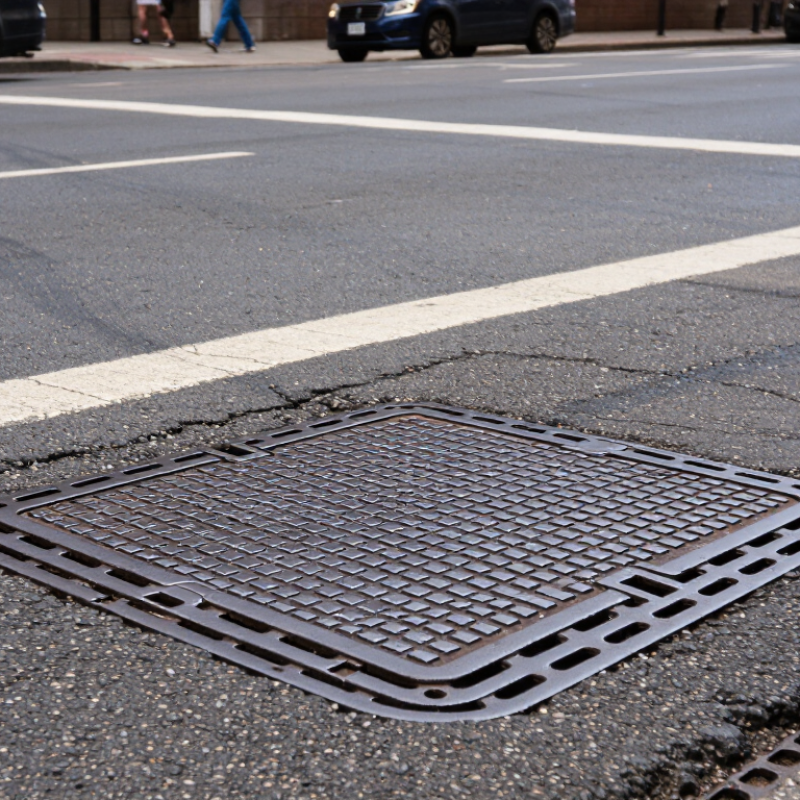
A typical cover includes a frame, locking or lifting features, and a textured surface for traction. Engineers select its load class according to location, traffic, and installation conditions. A cover for a quiet walkway needs less capacity than one installed on a busy road. The exact rating should come from tested design data, not appearance alone. Heavy does not always mean suitable.
Field inspections often reveal practical details. A poorly seated frame may rock, collect water, or create a sharp driving noise. Dirt inside the seating area can cause this problem. Regular cleaning and inspection help preserve stability. Corrosion protection also depends on the environment, drainage, and coating quality. No cover is perfect. Even strong ductile iron can fail when the frame is badly supported or the opening is measured incorrectly. For reliable selection, check dimensions, load classification, surface condition, and local installation requirements together.
Why Choose Ductile Iron Manhole Covers? - What Are Ductile Iron Manhole Covers?
| Data Dimension | Typical or Relevant Data | Why It Matters |
|---|---|---|
| Definition | A ductile iron manhole cover is a removable access cover cast from spheroidal graphite cast iron and installed over underground utility chambers. | It provides access for inspection and maintenance while protecting people, vehicles, and underground infrastructure. |
| Material Structure | The graphite forms rounded nodules rather than flakes, typically produced by treating molten iron with magnesium before casting. | The nodular structure improves strength, toughness, and resistance to impact compared with ordinary gray cast iron. |
| Common Material Grade | Ductile iron grades are commonly specified under standards such as EN 1563 or ASTM A536. Mechanical properties depend on the selected grade and casting design. | A defined grade allows engineers to verify tensile strength, yield strength, elongation, and quality requirements. |
| Typical Density | Approximately 7.1–7.3 g/cm³, depending on composition and graphite content. | The high density contributes to a solid, stable cover that is less likely to move under traffic or vibration. |
| Load Classification | EN 124-2 classes include A15, B125, C250, D400, E600, and F900, with test loads ranging from 15 kN to 900 kN. | The class should match the installation location, from pedestrian areas to heavily loaded airport or industrial zones. |
| Typical Roadway Class | D400 is commonly used for carriageways, hard shoulders, and areas exposed to moving road traffic, when specified by the project design. | Correct classification helps prevent structural failure caused by repeated wheel loads. |
| Strength and Toughness | Ductile iron generally offers higher tensile strength and impact resistance than conventional gray cast iron, although exact values depend on the grade. | The cover is better suited to traffic, vibration, accidental impact, and repeated loading. |
| Design Options | Available configurations may include circular, square, or rectangular covers; solid or ventilated designs; hinged or loose covers; and locking or non-locking systems. | The design can be selected for access requirements, ventilation, security, drainage, and installation space. |
| Surface Finish | Raised ribs, recessed patterns, or textured surfaces are commonly used to improve traction. Protective coatings may include bituminous paint or other specified systems. | Texture helps reduce slipping, while coatings can limit corrosion during storage and service. |
| Corrosion Performance | Ductile iron is not corrosion-proof. Performance depends on soil, moisture, salts, wastewater conditions, coating, and maintenance. | Environmental conditions should be assessed before selecting a coating or corrosion protection system. |
| Noise and Stability | A properly fitted cover and frame can reduce rocking, impact noise, and movement. Locking or gasketed designs may provide additional control. | Stable installation improves road-user comfort and reduces damage to the frame and surrounding pavement. |
| Service Life | A well-designed, correctly installed, and properly maintained cover can provide long service life; actual life varies with loading, environment, and maintenance. | Durability can reduce replacement frequency and whole-life maintenance costs. |
| Recyclability | Iron and steel products can generally be recycled at the end of their useful life through established metal-recycling processes. | Recyclability supports material recovery and can reduce demand for new raw materials. |
| Key Selection Criteria | Check clear opening, external dimensions, frame depth, load class, installation location, ventilation needs, locking requirements, coating, and applicable local standards. | Correct selection ensures compatibility, safety, and reliable performance in the intended application. |
Note: Load capacity, dimensions, mechanical properties, and coating performance vary by product design, manufacturing process, installation method, and applicable standard. Always verify project-specific requirements before installation.