
Roof Drains are quiet infrastructure, yet they decide whether a commercial roof stays reliable during intense rainfall. A blocked outlet can turn a flat membrane into a shallow pond within hours. Water then presses against seams, insulation, flashing, and interior ceilings. The National Roofing Contractors Association’s Roofing Manual identifies positive drainage as a core roof-performance requirement. FM Global Data Sheet 1-54 also stresses rainfall intensity, outlet capacity, overflow protection, and maintenance access. These are design decisions, not decorative details.
The global market offers many drainage configurations, including cast iron outlets, aluminum drains, siphonic systems, scupper drains, planter drains, and emergency overflow outlets. Each type responds to different roof areas, climates, structural limits, and maintenance conditions. ASCE 7-22 provides load criteria that engineers may consider when ponding and rainfall affect roof design. Local rainfall records still matter. A product that performs well in Rotterdam may fail in Singapore without revised sizing and detailing.
Joseph Lstiburek, Ph.D., a respected building-science expert, often emphasizes, “Water is the most destructive force on Earth.” His warning applies directly to Roof Drains. This guide compares ten widely used types for global buyers, focusing on capacity, materials, installation, inspection, and lifecycle value. It is not a universal ranking. That would be too simple. Drainage performance depends on engineering calculations, compatible components, and disciplined maintenance. Even a premium drain can fail when leaves cover its strainer. Buyers should verify standards, warranties, corrosion resistance, and local installer experience before selecting a system. Small omissions can become expensive repairs.
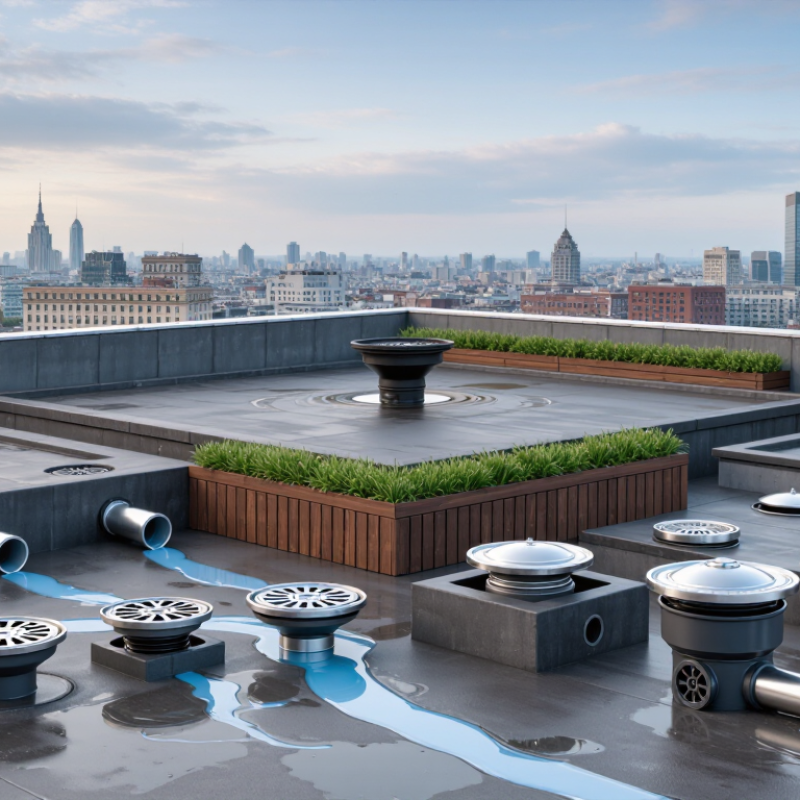
What Roof Drains Are and Why Global Buyers Need Them
Roof drains are engineered outlets that move rainwater from flat or low-slope roofs. They connect the roof surface to internal pipes, downspouts, or external discharge points. A strainer blocks leaves, gravel, and construction debris. Without proper drainage, water may collect around seams, penetrations, and rooftop equipment. Leaks can develop slowly. Structural loads can also increase.
Global buyers may compare ten common types, including dome drains, flat-grate drains, channel drains, scuppers, siphonic drains, overflow drains, balcony drains, green-roof drains, retrofit drains, and heated drains. Each design serves different conditions. Heavy rainfall requires suitable flow capacity. Cold regions may need freeze-resistant details. Coastal projects often require corrosion-resistant materials. Local codes, roof membranes, pipe sizes, and maintenance access must match. Specifications can look correct on paper, yet installation details may still fail. That is an uncomfortable but important reality.
Tips: Check rainfall intensity, outlet diameter, grate loading, and material compatibility before purchasing. Ask for test data, installation drawings, and maintenance instructions. Confirm certification requirements with a qualified local engineer. Keep access clear after installation. A cheaper drain may become expensive when debris blocks it or replacement parts cannot arrive quickly. Where roof layouts are complex, request hydraulic calculations instead of guessing.
Roof drains collect and discharge rainwater from roofs, terraces, balconies, parking decks, and landscaped roofs. The chart shows commonly specified outlet or opening size ranges for ten roof-drain types. Actual sizing depends on rainfall intensity, catchment area, roof slope, hydraulic design, and local building codes.
Data note: The size bands are indicative metric specification ranges commonly encountered in international roof-drain projects. They are not a substitute for project-specific hydraulic calculations or code review.
Roof drains are classified by water movement, installation position, and roof structure. The main groups include internal drains, scuppers, gutters, siphonic drains, overflow drains, and point drains. Internal point drains sit below the waterproofing layer and connect to vertical pipes. Scuppers discharge water through parapet walls. Gutters collect runoff along roof edges. Simple differences matter.
Designers also classify drains by hydraulic behavior. Conventional drains use gravity and partially filled pipes. Siphonic systems use controlled air exclusion to create faster flow. Overflow drains provide a secondary escape route when primary outlets clog. The National Roofing Contractors Association emphasizes coordinated drainage, flashing, and membrane detailing in its Roofing Manual. Drain selection cannot be separated from roof assembly.
Material creates another classification. Common options include cast iron, stainless steel, aluminum, copper, and polymer-based components. The choice depends on corrosion exposure, roof chemistry, maintenance access, and local standards. NOAA Atlas 14 rainfall data helps engineers select design rainfall intensities for specific locations. One global product cannot fit every climate. The U.S. Environmental Protection Agency reports that green roofs may retain roughly 50% to 80% of annual rainfall, depending on climate and design. That figure is useful, but not universal. Some drainage guides also understate debris risk. In practice, leaves, ice, and poor slope often cause more trouble than the drain body itself.
Roof drains differ by roof shape, rainfall, and maintenance access. Flat roof drains use a strainer dome to stop leaves and gravel. Siphonic drains create full-bore flow for large commercial roofs. Overflow drains provide a visible safety route when primary outlets fail. Gutter drains collect water along sloped edges. Scuppers discharge water through parapet walls.
Channel drains suit terraces, balconies, and narrow roof sections. Dome drains perform well where debris is common. Planter drains manage water around green roof systems. Balcony drains usually include compact grates and odor-control traps. Emergency drains protect buildings during extreme rainfall.
Each type has a practical application. Siphonic systems can reduce pipe diameter, but they require accurate hydraulic design. Scuppers are easy to inspect, though strong wind may affect discharge. Planter drains need filter layers to prevent soil migration. A balcony drain may clog quickly under fine sand and fallen leaves. Field inspections often reveal poor falls around outlets. Water can remain beside the drain, even when the product is correctly sized. Local building codes, rainfall data, roof loading, and fire requirements should guide selection.
Tips: Confirm the outlet diameter and waterproofing detail before purchase. Request flow-rate data, installation drawings, and material specifications. Check access for cleaning after storms. Do not rely on appearance alone. A larger drain is not always better; poor pipe routing can still cause ponding. Allowing for future maintenance is sometimes overlooked, and that mistake can become expensive.
Comparing roof drains starts with rainfall, not outlet diameter. NOAA Atlas 14 precipitation-frequency data shows 100-year, one-hour rainfall exceeding 4 inches in parts of the United States. Local values vary sharply. Use the project location, roof area, slope, and runoff coefficient when estimating flow. A larger outlet is not automatically safer. Blocked strainers, undersized leaders, and poor falls can still create ponding.
For the ten drain types, compare drainage capacity under identical conditions. Internal gravity drains suit many flat roofs, while siphonic systems can move high flows with fewer vertical leaders. Scuppers and overflow drains provide visible emergency relief. Dome, flat-grate, channel, and balcony drains require different inlet assumptions. EN 12056-3 and EN 1253 provide useful European design and product references. In North America, ASME A112.6.4 addresses roof, deck, and balcony drains. Local building rules still control acceptance.
Material selection needs equal discipline. Stainless steel resists many corrosive environments, but may cost more. Cast iron offers weight and durability. Polymer drains reduce corrosion concerns, yet temperature and fire performance need verification. Check tested flow rates, connection dimensions, load ratings, and coating compatibility. The WMO State of Global Climate 2023 reported continuing extreme weather pressure worldwide, making old rainfall assumptions less comfortable. A spreadsheet may look exact. Its storm intensity, blockage allowance, or overflow path may still be wrong. Review those assumptions with a qualified drainage engineer before purchase.
| No. | Roof Drain Type | Typical Applications | Common Outlet Sizes | Indicative Drainage Capacity* | Common Materials | Main Advantages | Important Selection Considerations | Relevant Standards or Guidance |
|---|---|---|---|---|---|---|---|---|
| 1 | Conventional Flat Roof Drain | Commercial roofs, industrial buildings, warehouses, and low-slope membrane roofs | 75–150 mm (3–6 in) | Approximately 4–12 L/s for a 75–150 mm outlet under conventional gravity-flow conditions | Cast iron, ductile iron, aluminum, stainless steel, or polymer bodies | Simple layout, broad availability, and compatibility with many roof membranes | Check clamping-ring compatibility, sump depth, outlet connection, strainer height, and waterproofing details | ASME A112.6.4; EN 1253-2; local plumbing and roof-drainage regulations |
| 2 | Cast-Iron Roof Drain | Heavy-duty commercial roofs, podium decks, parking structures, and high-traffic areas | 75–200 mm (3–8 in) | Approximately 5–18 L/s, depending on outlet diameter, head, strainer, and connected piping | Cast iron, ductile iron, stainless steel strainers, and elastomeric seals | High mechanical strength, good fire performance, and long service life when protected from corrosion | Greater weight, lifting requirements, corrosion protection, and compatibility with the drainage pipe system | ASME A112.6.4; EN 1253-2; ASTM A48/A48M may apply to gray iron components where specified |
| 3 | Aluminum Roof Drain | Lightweight roof assemblies, retrofit projects, metal roofs, and areas where corrosion resistance is needed | 75–150 mm (3–6 in) | Approximately 4–14 L/s under conventional gravity-flow conditions | Cast or spun aluminum, stainless steel hardware, and rubber or EPDM seals | Low weight, good resistance to atmospheric corrosion, and easier installation | Avoid direct contact with incompatible metals; verify galvanic-corrosion protection and temperature limitations | ASME A112.6.4; EN 1253-2; EN 755 or ASTM B221 may be relevant to aluminum extrusions |
| 4 | Stainless-Steel Roof Drain | Coastal buildings, food-processing facilities, hospitals, terraces, and chemically exposed environments | 50–150 mm (2–6 in) | Approximately 3–14 L/s under conventional gravity-flow conditions | Austenitic stainless steel, commonly grades 304 or 316, with EPDM or equivalent seals | Strong corrosion resistance, hygienic surface, and good appearance | Select the stainless-steel grade according to chloride exposure, chemicals, welding quality, and seal compatibility | ASME A112.6.4; EN 1253-2; EN 10088 for stainless-steel material designations |
| 5 | PVC Roof Drain | Lightweight membrane roofs, residential buildings, and systems using plastic drainage pipework | 75–150 mm (3–6 in) | Approximately 3–14 L/s, subject to the drain geometry and piping layout | uPVC or PVC components, stainless-steel or polymer strainers, and elastomeric seals | Lightweight, corrosion-resistant, and compatible with solvent-welded plastic pipe systems | Check UV exposure, thermal movement, fire classification, solvent compatibility, and membrane connection method | ASME A112.6.4; EN 1253-2; ASTM D2665 or applicable local PVC drainage standards |
| 6 | Siphonic Roof Drain | Large commercial roofs, airports, logistics centers, factories, and buildings requiring fewer downpipes | 75–150 mm (3–6 in) | Approximately 8–25 L/s per outlet in a properly engineered full-bore siphonic system | HDPE, stainless steel, aluminum, cast iron, and engineered polymer components | High flow per outlet, smaller horizontal pipe gradients, and reduced vertical pipe count | Requires hydraulic calculation, air-separation control, dedicated pipework, structural coordination, and specialist commissioning | EN 12056-3; ASPE standards and local plumbing regulations; project-specific hydraulic design criteria |
| 7 | Overflow or Emergency Roof Drain | Secondary drainage for flat roofs, critical facilities, and roofs where ponding must be limited | 75–150 mm (3–6 in) outlets; opening sizes vary by design | Approximately 3–15 L/s, calculated for the emergency drainage route and design head | Cast iron, aluminum, stainless steel, PVC, or composite materials | Provides independent protection if primary drains become blocked or overloaded | Must discharge visibly or to a separately designed system; set elevation carefully to protect roof structure | International Building Code provisions where applicable; ASME A112.6.4; local emergency drainage requirements |
| 8 | Roof Scupper Drain | Parapet roofs, balconies, canopies, and external discharge points through walls | 100–300 mm wide openings; outlet depth commonly 75–150 mm | Approximately 4–20 L/s, depending on opening width, water depth, and outlet configuration | Aluminum, stainless steel, copper, galvanized steel, PVC, or coated metal | Simple emergency discharge path, visible flow, and suitability for parapet construction | Coordinate with wall flashing, overflow height, exterior splash control, freeze protection, and facade drainage | ASCE 7 rainfall data; International Building Code provisions where applicable; local roof and plumbing codes |
| 9 | Green Roof Drain with Inspection Chamber | Extensive and intensive vegetated roofs, roof gardens, and podium landscapes | 75–150 mm (3–6 in) | Approximately 3–12 L/s after accounting for the grate, filter layer, and inspection chamber | Polypropylene, recycled polymer, stainless steel, aluminum, or cast iron | Limits growing-media migration, permits inspection, and supports maintenance access | Confirm root resistance, filter fabric compatibility, maintenance clearance, load capacity, and adjustable height | FLL Green Roof Guidelines; EN 1253-2 where applicable; local green-roof and drainage regulations |
| 10 | Balcony and Terrace Drain | Residential balconies, terraces, roof decks, walkways, and small exposed platforms | 50–100 mm (2–4 in) | Approximately 1–8 L/s under gravity-flow conditions | Stainless steel, cast iron, aluminum, PVC, ABS, or polymer composites | Compact dimensions, low-profile grates, and compatibility with tile or liquid-applied waterproofing | Check grate loading class, tile thickness, waterproofing flange, odor trap requirements, and freeze conditions | EN 1253 series; ASME A112.6.4 where applicable; EN 1433 may apply to linear drainage channels |
Global buyers should select roof drains by rainfall intensity, roof structure, maintenance access, and local standards. The shortlist may include gravity drains, siphonic drains, overflow drains, scuppers, channel drains, balcony drains, internal outlets, external outlets, parapet drains, and emergency drains. Materials also matter, including cast iron, stainless steel, aluminum, and polymer options.
Local engineering data should guide every purchase. The WMO’s State of the Global Climate 2023 confirmed exceptional heat and widespread climate extremes. More intense rain can quickly expose weak drainage design. Buyers should request tested flow rates, outlet dimensions, load ratings, corrosion resistance, and compatible waterproofing details. Verify hydraulic capacity against EN 12056-3 or the applicable national code. A drain that fits the pipe may still fail at the roof membrane.
Sourcing teams should compare drawings, inspection records, packaging quality, and replacement-part availability. Ask suppliers for test reports from accredited laboratories, not only attractive catalog figures. The UNEP Global Status Report for Buildings and Construction 2023 noted that buildings produced about 37% of global energy and process-related emissions. Durable drainage supports longer service life, although sustainability claims need evidence. A low-cost unit can become expensive after blocked strainers, leaking seals, or difficult access. The perfect specification does not exist. Recheck assumptions with a local engineer before approving the order.
Phone: (256) 845-1255 or (256) 845-4493
Fax: (256) 845-1321 or (256) 845-4468
© 2025 Heritage Wire Harness, LLC