
Choosing a Turbine Generator For Wte is not simply a matter of selecting the highest-rated machine. Waste changes daily. Its moisture, ash content, heating value, and corrosive compounds can shift within hours. A reliable choice must match these realities.
Dr. Marco J. Castaldi, a recognized waste-to-energy researcher, has stated, “Waste-to-energy is not a solution to waste management; it is a solution to energy recovery from waste.” His observation keeps turbine selection grounded. The generator should support safe energy recovery, not distract from responsible waste handling.
Begin with the plant’s steam conditions, including pressure, temperature, flow rate, and expected operating hours. Then examine turbine efficiency under partial loads. A unit designed only for peak performance may waste energy during low-throughput periods. That matters in facilities receiving uneven waste deliveries.
Corrosion resistance deserves close attention. Chlorides, sulfur compounds, and fly ash can damage blades, seals, and condenser surfaces. Maintenance access also affects long-term performance. A technically impressive turbine may become expensive if inspections require extended shutdowns.
Grid requirements matter too. The generator must deliver stable power while handling sudden load changes. Heat recovery may also influence the final design, especially when nearby factories or district heating networks can use low-pressure steam.
There is no perfect specification. Early calculations can be overly optimistic. Real waste is less predictable than a laboratory sample. This guide explains how to compare turbine types, estimate practical output, assess lifecycle costs, and question supplier claims before committing to a Turbine Generator For Wte.
How to Choose a Turbine Generator for Waste to Energy?
Understanding Waste-to-Energy Turbine Generator Systems
A waste-to-energy system begins with uneven fuel, not uniform coal. Municipal waste changes daily in moisture, plastics, ash, and heating value. The World Bank’s What a Waste 2.0 report projects global municipal waste will reach 3.4 billion tonnes annually by 2050. That variability directly affects boiler pressure, steam flow, and turbine output.
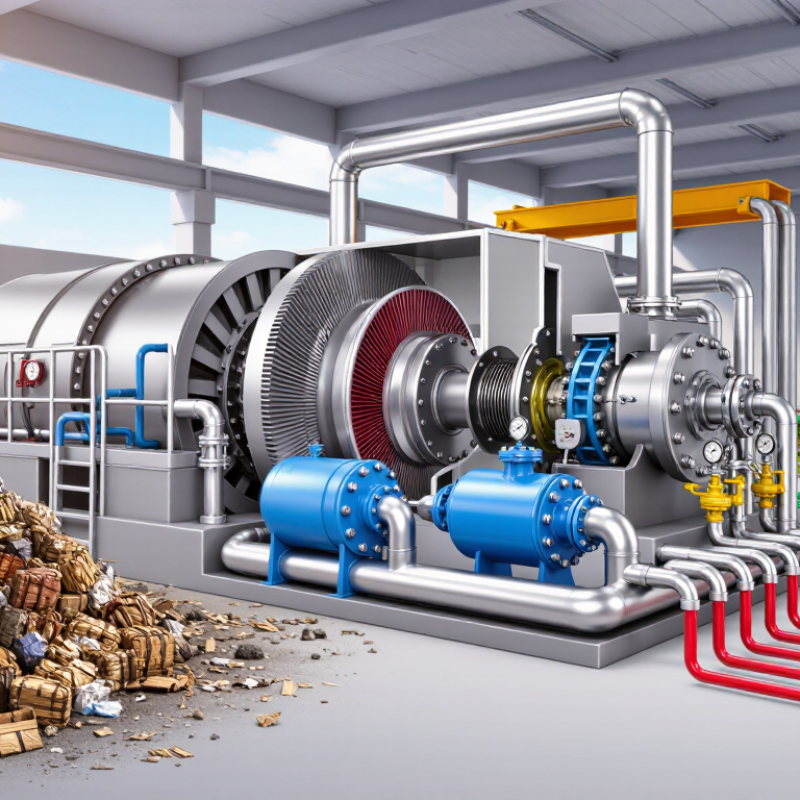
The complete system includes waste reception, combustion, heat recovery, steam generation, turbine expansion, electrical generation, condensation, and emissions control. A condensing turbine suits electricity-focused plants. A back-pressure turbine may perform better when nearby industries need steady process heat. The U.S. Environmental Protection Agency reports that combustion can reduce waste volume by roughly 90 percent. However, volume reduction does not remove corrosion, fouling, or ash-handling challenges.
Choose the generator around real operating conditions. Review lower heating value, annual availability, steam temperature, grid requirements, cooling-water limits, and expected load changes. European Commission waste-incineration guidance emphasizes corrosion control and reliable flue-gas treatment under demanding conditions. Operators should also inspect turbine materials and maintenance access, not only rated efficiency. Small details matter.
A perfect forecast is unlikely.
A spreadsheet can mislead.
Field experience often reveals the gap between design assumptions and wet winter waste. Conservative steam conditions may reduce peak output, but they can improve availability and equipment life. That trade-off deserves honest discussion before procurement.
Choosing a turbine generator begins with the waste fuel, not the equipment catalogue. Waste is not a stable fuel like natural gas. Its moisture, ash, chlorine, sulfur, and heating value can change daily. Measure these properties across seasons and delivery batches. Moisture lowers combustion temperature and usable energy. High ash may increase fouling and disposal costs. Chlorine can accelerate corrosion in high-temperature sections. One sample misleads.
The turbine should match the available steam conditions and operating pattern. For wet waste, the boiler may need more energy before producing useful steam. The selected turbine must handle expected pressure, temperature, and flow ranges without losing efficiency during partial operation.
A heat recovery system can improve overall performance when nearby users need process heat. However, unstable steam quality may create vibration, erosion, or control problems. Small errors grow.
In plant assessments, engineers often compare laboratory data with several weeks of operating records. Continuous monitoring is valuable. Operators should track fuel moisture, furnace temperature, steam pressure, exhaust temperature, and generator output. A neat spreadsheet can still mislead when sampling is poor. I would also question optimistic heating-value estimates, especially when waste arrives mixed or compacted. Real-world performance depends on maintenance access, ash cleaning intervals, grid requirements, and the operator’s ability to respond to sudden fuel changes.
Matching turbine type and capacity to plant operating conditions requires more than reading the boiler rating. Waste fuel changes constantly. Moisture, ash, and heat value can shift during one operating day. These variations affect steam pressure, temperature, and flow. A turbine should match the plant’s usual conditions, not only its highest recorded output. The first estimate is rarely right.
For steady steam demand, a back-pressure turbine can supply process heat while producing electricity. A condensing turbine may suit plants focused on power generation, especially when excess steam is available. Combined configurations can support both needs, but they require careful control.
Review the main steam pressure, exhaust pressure, cooling-water temperature, and annual operating hours. Small details matter. A five-degree temperature change can influence expansion efficiency and exhaust conditions.
Capacity selection should include realistic operating limits. Oversizing may create unstable low-load operation, while undersizing can waste available steam during peak periods. Engineers should compare hourly steam data, planned maintenance, startup frequency, and seasonal waste composition. Allowance for fouling and gradual equipment wear is also important.
In practical projects, the design margin is often too generous. That choice looks safe, but it can reduce part-load efficiency. A transparent performance test, clear efficiency guarantees, and verified control logic improve purchasing confidence. The final specification should reflect measured plant data, not optimistic assumptions.
Choosing a turbine generator for waste-to-energy begins with steam quality, not nameplate output. IEA Bioenergy reports that electricity-only waste combustion commonly achieves about 15–30% net efficiency. Higher efficiency often requires hotter, drier steam. That choice can accelerate chloride corrosion and superheater fouling. A smaller turbine may produce less power, yet survive unstable waste conditions better. Where heat has a reliable buyer, IEA Bioenergy reports that combined heat and power efficiency can exceed 50%.
Emissions are controlled mainly by combustion and flue-gas systems, but turbine selection still matters. The European Union’s 2019 BAT Conclusions list NOx levels of 50–150 mg/Nm³ under defined operating conditions. The same report gives dust levels of 2–5 mg/Nm³. These values are not guaranteed by a turbine. Select a unit that tolerates steam bypasses during cleaning and rapid load changes. Poor integration can increase auxiliary power and reduce net efficiency.
Reliability depends on inspection access, spare parts, and planned outages. Track forced-outage history, vibration limits, bearing temperatures, and rotor inspection intervals. EIA generator datasets show that capacity factors vary widely among waste facilities. Do not trust one efficiency figure. Real plants are messier. An annual availability target near 8,000 hours can hide difficult cleaning periods. Maintenance teams should examine deposits after each outage, because corrosion patterns often reveal incorrect steam chemistry, weak cleaning schedules, or unsuitable materials.
Representative comparison of efficiency, emissions, reliability, and maintenance requirements
Condensing steam turbines generally provide the highest net electrical efficiency in large waste-to-energy plants, while ORC systems typically require less planned maintenance and can perform well at smaller capacities. Back-pressure turbines are suitable where useful steam or district heating is required. Direct turbine NOx emissions are shown as zero because these turbine types do not combust fuel; most NOx emissions originate in the waste combustion and flue-gas treatment system. Values are representative engineering benchmarks and vary with plant scale, steam conditions, waste composition, and operating strategy.
How to Choose a Turbine Generator for Waste to Energy?
Evaluating Costs, Safety Standards, and Long-Term Performance
Choosing a turbine generator begins with the waste stream, not the catalogue. Measure steam pressure, temperature, flow, moisture, and seasonal variation over several months. A unit sized only for peak output may operate inefficiently during low-load periods. That mistake is common. During commissioning, operators should compare actual heat rates with design predictions and record every adjustment.
Cost evaluation must include installation, fuel preparation, water treatment, staffing, spare parts, and planned outages. A cheaper generator can become expensive when corrosion damages blades or condensate contaminates the lubrication system. Request a transparent lifecycle model, including estimated availability and maintenance intervals. Independent engineering review can expose optimistic assumptions before contracts are signed.
Safety requires more than a compliance certificate. Confirm alignment with applicable electrical, pressure equipment, machinery, emissions, and grid-connection standards. Inspect overspeed protection, emergency shutdowns, vibration monitoring, fire detection, and safe access around hot surfaces. Ask how interlocks are tested, not merely whether they exist. Long-term performance depends on disciplined operation, clean instrumentation, and timely inspections. Waste-derived steam is rarely consistent. That reality complicates forecasting. Even experienced teams may underestimate ash-related fouling or changing waste composition. Build performance testing, operator training, and data review into the project plan, while leaving room for corrective changes.
| Evaluation Dimension | Condensing Steam Turbine | Extraction-Condensing Steam Turbine | Back-Pressure Steam Turbine | Selection Guidance for Waste-to-Energy Projects |
|---|---|---|---|---|
| Typical operating role | Maximizes electricity production by expanding steam to a condenser. | Produces electricity while allowing controlled steam extraction for district heating or industrial use. | Discharges useful process or heating steam at a controlled pressure instead of condensing it fully. | Choose according to the project’s electricity demand, heat-offtake requirements, and seasonal load profile. |
| Typical electrical capacity | Approximately 5–40 MW for many municipal waste-to-energy plants. | Approximately 5–40 MW, depending on steam production and heat demand. | Approximately 1–30 MW, commonly selected for combined heat and power applications. | The generator rating should reflect normal, minimum, and maximum steam flows rather than boiler nameplate capacity alone. |
| Typical net electrical efficiency | About 18–30% of the waste feedstock’s lower heating value, depending on steam conditions and plant auxiliaries. | About 15–27% when substantial steam is extracted for heat use. | About 10–25% when optimized for useful heat delivery rather than electricity alone. | Use net efficiency after deducting fans, pumps, flue-gas treatment, conveyors, and other plant loads. |
| Overall CHP energy utilization | Usually lower when no useful heat market exists; excess condenser heat is rejected. | Typically about 55–85% when extracted steam has a stable heat customer. | Typically about 60–85% when the useful heat load is continuous and properly matched. | CHP performance depends more on heat utilization than on turbine design alone. |
| Indicative turbine-generator island cost | Approximately USD 1,000–2,500 per kW for equipment and installation allowance, excluding boiler, flue-gas treatment, buildings, and civil works. | Approximately USD 1,200–2,800 per kW because of extraction controls, valves, and additional steam-system equipment. | Approximately USD 900–2,200 per kW, depending on steam pressure, controls, and heat-delivery equipment. | Use these as early-stage planning ranges only; site conditions, currency, capacity, and contract scope can materially change costs. |
| Recommended steam conditions | Commonly about 40–65 bar(a) and 380–450°C for modern waste-to-energy service, subject to corrosion and deposit limits. | Commonly about 40–65 bar(a) and 380–450°C, with extraction pressures designed around the heat network. | Inlet conditions may be similar, while outlet steam pressure is often about 2–15 bar(a), depending on the process or heating system. | Higher pressure and temperature can improve efficiency but may increase corrosion, materials, inspection, and maintenance requirements. |
| Expected annual availability | Approximately 90–95% for a well-maintained plant with planned outage management. | Approximately 90–95%, with additional attention required for extraction valves and control systems. | Approximately 90–96% when steam demand is stable and the system is not frequently operated outside its design range. | Availability targets must include boiler outages, condenser limitations, grid restrictions, and waste-feed interruptions. |
| Design service life | Typically 25–30 years with periodic inspections, rotor assessment, and major overhauls. | Typically 25–30 years, subject to extraction-system integrity and control-system upgrades. | Typically 25–30 years, provided exhaust-pressure conditions and heat loads remain within design limits. | Require documented lifecycle support, spare-parts availability, and a planned modernization path for controls and electrical systems. |
| Major overhaul interval | Usually every 5–8 years, depending on operating hours, starts, vibration, and steam quality. | Usually every 5–8 years, with additional inspection of extraction stages and valves. | Usually every 5–8 years, depending on load cycling and exhaust-steam conditions. | Budget for outage labor, rotor inspection, seals, bearings, valve testing, generator testing, and control-system updates. |
| Primary operational risk | Condenser fouling, cooling-water restrictions, wet-steam erosion, and low-load efficiency loss. | Steam-demand fluctuations, extraction-valve failure, and unstable heat-network pressure. | Loss of the heat customer, excessive exhaust pressure, and inability to maintain the required process-steam conditions. | Complete a failure-mode review covering steam quality, condenser performance, grid connection, and heat-offtake reliability. |
| Key safety and design standards | Common references include IEC 60045-1 for steam turbines, IEC 60034 for rotating electrical machines, ASME B31.1 for power piping, ASME Boiler and Pressure Vessel Code for pressure equipment, EN 12952 for water-tube boilers where applicable, and NFPA 850 or equivalent fire-protection requirements. | The applicable legal requirements depend on the project country, pressure category, grid code, fire authority, and environmental permit. | ||
| Minimum performance guarantees to request | Net power output, steam rate, heat rate, generator efficiency, vibration limits, condenser back pressure, ramp rate, noise level, emissions-related auxiliary power, and guaranteed availability. | Guarantees should be measured using agreed test codes, defined ambient conditions, and clearly stated waste composition and steam-quality assumptions. | ||
| Best-fit project profile | Projects prioritizing electricity export and having limited or unreliable heat demand. | Projects with both electricity sales and a dependable district-heating or industrial heat customer. | Projects where useful heat has a high value and a stable year-round customer is available. | Select the configuration that maximizes risk-adjusted lifecycle revenue, not simply the highest rated electrical output. |
Phone: (256) 845-1255 or (256) 845-4493
Fax: (256) 845-1321 or (256) 845-4468
© 2025 Heritage Wire Harness, LLC