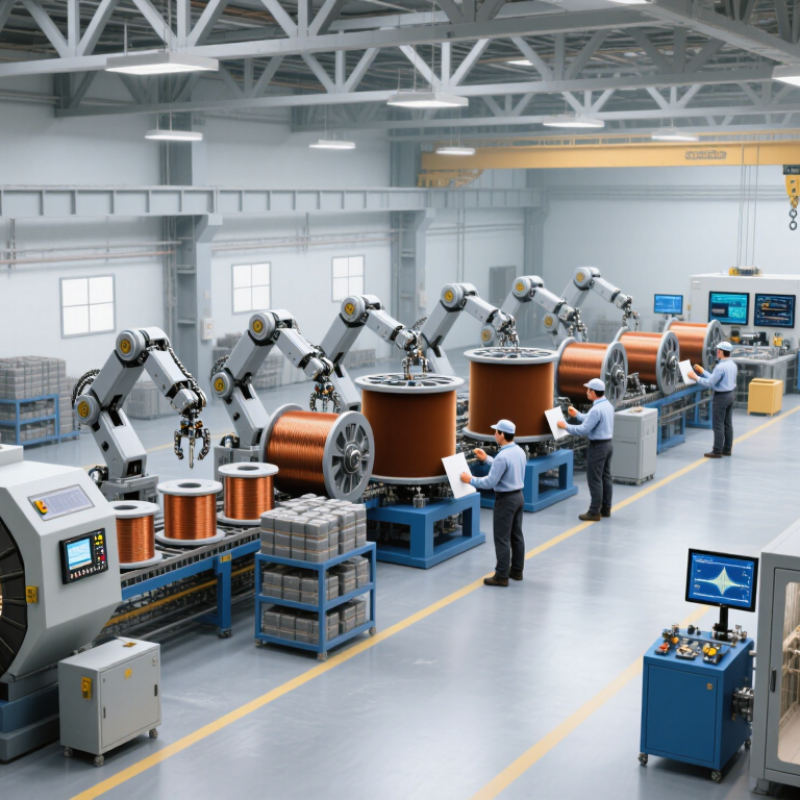
Choosing a Transformer Production Line in 2026 requires more than comparing machine prices. The decision affects safety, output quality, energy use, and future expansion.
S. V. Kulkarni, a respected transformer-design author, states, “Transformer design is always a compromise between cost, performance, and reliability.” That principle also guides production-line selection. A low-cost line may look attractive, yet poor winding tension can create uneven coils. Weak core cutting accuracy can increase losses. Inconsistent vacuum drying can shorten insulation life.
Examine the complete process, not isolated equipment. The line should connect core cutting, stacking, winding, assembly, vacuum drying, oil filling, and final testing. Ask suppliers for measured cycle times. Request sample test records. Visit a working factory, if possible. Watch how operators handle copper conductors, insulation paper, and heavy tank components.
Digital traceability matters in 2026. Each transformer should carry searchable records for materials, torque values, drying temperature, pressure, and electrical tests. Automated inspection can reduce errors, but it cannot replace experienced technicians. That assumption deserves caution.
Consider your actual product range. A small distribution transformer line needs different flexibility than a high-voltage power transformer facility. Check tooling changes, floor space, crane capacity, ventilation, utilities, and maintenance access. Also review training support and spare-parts availability.
There is no perfect answer. I would not choose the fastest line automatically. A slower system with stable quality may deliver stronger lifetime value. The best Transformer Production Line matches your products, workforce, factory conditions, compliance needs, and realistic growth plans.
How to Choose a Transformer Production Line in 2026?
Choosing a transformer production line in 2026 starts with a precise product definition. Do you build dry-type, oil-immersed, distribution, power, or specialized transformers? Each type changes insulation handling, tank fabrication, winding control, testing, and worker training. A dry-type line may prioritize resin casting and controlled curing. An oil-immersed line needs tank welding, leak checks, oil processing, and careful sealing. Small details matter.
Write the rating schedule before requesting equipment proposals. Record voltage class, rated power, frequency, phase, impedance, tap range, insulation level, and cooling method. Also define core dimensions, conductor material, coil geometry, and expected annual volume. A 10 MVA unit and a 100 kVA unit cannot share identical tooling. Their lifting systems, ovens, winding machines, and test capacity differ. Missing one value can distort the entire line design.
Production requirements should connect engineering data with measurable factory conditions. Set targets for cycle time, yield, traceability, inspection points, energy use, and maintenance access. Specify routine and type tests according to applicable standards and customer requirements. Include dielectric tests, temperature-rise testing, short-circuit strength checks, and partial-discharge evaluation where applicable. Do not purchase maximum capacity automatically. Excess capacity increases cost and may reduce utilization. A practical line should allow future ratings without rebuilding every station. That balance is difficult. Review the plan with design, production, quality, and service engineers. Their disagreement can reveal assumptions that look reasonable on paper. Some requirements will remain uncertain; document them instead of hiding them.
Transformer type and rated capacity directly affect production-line requirements. Distribution transformers commonly use coil-winding, core cutting, tank fabrication, drying, oil filling, and routine testing equipment. Dry-type transformers require additional insulation preparation, casting or resin-processing capability, and controlled curing. Power transformers require larger handling systems, vacuum drying, high-voltage testing, and more extensive quality-control processes.
A reliable production line begins with disciplined core material control. Compare electrical steel by loss, thickness, coating quality, and cutting tolerance. Grain-oriented steel needs accurate joint cutting and careful stacking to reduce magnetic losses. Amorphous metal requires different handling because its strip is thin and easily damaged. Small details matter. Inspectors should record batch numbers, surface defects, and core clamping pressure. A material that looks acceptable may still create noise, heat, or unstable test results.
Winding equipment must match the transformer design, conductor shape, and insulation system. Disc, layer, and foil windings each need different tension control. Excessive tension can damage insulation, while loose winding creates movement during short-circuit conditions. Check whether the line controls wire alignment, axial dimensions, and interlayer spacing automatically. Manual correction is sometimes useful, but it also introduces inconsistency. That weakness deserves honest review. Measure winding resistance and dimensions during production, not only after completion.
Assembly quality depends on cleanliness, drying, connection accuracy, and traceable inspection. Look for controlled oil filling or resin casting procedures, depending on the transformer type. Vacuum drying should be verified with recorded temperature, pressure, and time data. Technicians should inspect lead connections, insulation distances, grounding points, and sealing surfaces. Final tests may include turns ratio, insulation resistance, dielectric strength, partial discharge, and temperature-related checks. A modern line is not necessarily the best line. Choose equipment that produces repeatable evidence, supports trained operators, and exposes process errors before they become field failures.
How to Choose a Transformer Production Line in 2026?
A suitable transformer production line should match your product range, not only your output target. Manual lines offer lower investment and easier adjustments for small batches. Semi-automatic lines can improve winding consistency and reduce operator fatigue. Fully automated systems provide stable cycle times, digital records, and tighter process control. However, automation is not automatically better. A factory producing several custom models may lose time during complex changeovers.
Examine equipment features closely. Servo-driven winding machines should control tension, speed, and layer position accurately. Core cutting equipment needs clean edges and repeatable dimensions. Vacuum drying systems should provide stable temperature and pressure records. Electrical testing equipment must support insulation, ratio, resistance, and leakage checks. Ask for sample data, maintenance schedules, and factory acceptance testing. In my experience, small interface delays can become expensive when repeated hundreds of times. Some line specifications look impressive but ignore operator training.
Tips: Map your actual products before selecting equipment. Record transformer dimensions, winding materials, batch sizes, and monthly changeovers. Choose modular tooling when future models are uncertain. Check whether sensors can be recalibrated locally. Leave space around machines for inspection and maintenance. A flexible line may sacrifice peak speed, but it can handle design changes with less disruption. Reconsider any proposal that promises maximum output without showing setup time, rejection rates, and energy use.
How to Choose a Transformer Production Line in 2026?
Choosing a transformer production line in 2026 means testing the process, not admiring the equipment. Quality control should be visible at every station. Specify barcode traceability for steel, wire, insulation, and oil. Require calibrated winding-tension, torque, vacuum, and moisture instruments. IEC 60076-1 and IEC 60076-3 define important transformer and dielectric-test requirements. However, compliance documents cannot prove stable production. Ask for six months of capability data, first-pass yield, rework rates, and test failures. Short demonstrations can mislead.
Safety must be engineered into the layout and controls. Interlocked doors, emergency stops, guarded machinery, and safe discharge procedures need realistic testing. Use ISO 45001 principles when assessing risks from resin, oil, lifting, heat, and high voltage. Require documented lockout procedures and worker training records. One overlooked detail is maintenance access. A fast line is not safe if technicians must reach across energized equipment. My own preference is to reject vague safety claims, even when the factory looks exceptionally clean.
Energy efficiency needs measured evidence. The U.S. Department of Energy’s 2024 distribution-transformer rule projects 3.6 quadrillion British thermal units of energy savings over 30 years. That figure concerns deployed transformers, not factory consumption. Still, it should influence core design, electrical testing, and material selection. Measure kilowatt-hours per transformer, compressed-air leakage, furnace consumption, and idle power. ISO 50001 can support continuous energy monitoring. Do not accept only nameplate efficiency. Ask for production-site measurements, because optimistic estimates often hide standby losses.
| Evaluation Category | Production-Line Dimension | Practical Benchmark for 2026 | Why It Matters | Recommended Evidence to Request | Priority |
|---|---|---|---|---|---|
| Quality Control | Applicable product standards | Design and routine-test procedures aligned with IEC 60076 for power transformers, or the applicable national equivalent. | Confirms that the line supports recognized requirements for electrical, thermal, mechanical, and dielectric performance. | Standards matrix, design-calculation samples, type-test reports, and routine-test procedures. | Critical |
| Quality Control | Incoming-material traceability | 100% traceability for core steel, conductor, insulation materials, bushings, tap changers, and other safety-critical components. | Enables rapid root-cause analysis and prevents nonconforming materials from entering production. | Lot-number system, barcode or RFID records, supplier certificates, and quarantine workflow. | Critical |
| Quality Control | Core and winding process control | Automated or digitally recorded control of cutting dimensions, burr limits, winding tension, conductor placement, and compression force. | Reduces losses, hot spots, vibration, partial discharge risk, and variation between units. | Machine calibration records, process capability data, alarm history, and digital production logs. | Critical |
| Quality Control | Vacuum drying and oil processing | Vacuum drying, impregnation, and oil filling must be controlled by recorded pressure, temperature, time, moisture, and oil-quality parameters. | Moisture and dissolved gas contamination can significantly reduce insulation life and reliability. | Vacuum records, insulation-resistance results, moisture test results, oil filtration data, and calibration certificates. | Critical |
| Quality Control | Final electrical testing | Routine tests should include winding resistance, voltage ratio, polarity or phase displacement, impedance, no-load loss, load loss, dielectric tests, and, where specified, partial-discharge testing. | Detects assembly defects, incorrect connections, insulation weakness, and loss-performance deviations before shipment. | Test-plan cross-reference to IEC 60076, calibrated instruments, digitally signed reports, and nonconformance records. | Critical |
| Quality Control | Measurement-system capability | Test and measurement equipment calibrated to a documented schedule, with traceability to national or international measurement standards. | Reliable production decisions depend on accurate and repeatable measurements. | Calibration certificates, uncertainty statements, MSA or gauge R&R studies, and out-of-tolerance procedures. | High |
| Quality Control | Quality performance indicators | Request documented first-pass yield, rework rate, warranty-return rate, on-time delivery, and corrective-action closure time for comparable products. | Historical performance is more useful than advertised machine speed when comparing suppliers. | Anonymized 12-month KPI records, customer-acceptance data, and sample corrective-action reports. | High |
| Safety Standards | Machine electrical safety | Electrical equipment of machines should be designed and verified against IEC 60204-1 or the applicable local machine-safety standard. | Addresses protective bonding, emergency stops, overcurrent protection, control circuits, and electrical documentation. | Electrical schematics, protective-conductor test results, risk assessment, lockout/tagout procedure, and conformity documentation. | Critical |
| Safety Standards | Functional machine guarding | Interlocked guards, light curtains, access control, and emergency-stop devices should be risk-assessed and function-tested at defined intervals. | Prevents access to moving machinery, energized zones, hot surfaces, and stored-energy hazards. | ISO 12100-based risk assessment, safety-circuit validation, interlock test records, and inspection checklist. | Critical |
| Safety Standards | Fire and flammable-material controls | Oil handling, solvent use, hot work, and drying operations require fire detection, spill control, ventilation, compatible extinguishing equipment, and documented permits. | Transformer manufacturing may involve combustible liquids, heated equipment, and high-energy electrical systems. | Fire-risk assessment, emergency plan, spill-response plan, ventilation test results, and training records. | Critical |
| Safety Standards | Occupational health controls | Noise, fumes, welding emissions, lifting operations, chemical exposure, and ergonomic risks should be monitored and controlled under an ISO 45001-compatible system. | Reduces injury risk, occupational exposure, downtime, and compliance liabilities. | Exposure measurements, lifting plans, personal-protective-equipment assessment, training records, and incident statistics. | High |
| Safety Standards | Lifting and material handling | Cranes, vacuum tanks, winding fixtures, and lifting accessories should have rated capacities, inspection records, and clearly defined load paths. | Heavy transformer components create substantial dropped-load and crush hazards. | Load-test certificates, lifting plans, operator qualifications, inspection tags, and maintenance records. | Critical |
| Energy Efficiency | No-load and load-loss performance | Specify guaranteed losses at the contractual reference temperature and compare them with the applicable efficiency or eco-design requirements in the target market. | Transformer losses occur continuously over the service life and often exceed the production-line energy cost in financial impact. | Guaranteed-loss schedule, loss-calculation method, sample test certificates, and tolerance policy. | Critical |
| Energy Efficiency | Core-processing accuracy | The line should control cutting accuracy, joint quality, burr formation, stacking pressure, and core clamping to minimize magnetic losses and audible noise. | Core geometry and assembly quality directly influence no-load loss, excitation current, and noise. | Cutting tolerances, joint inspection records, core-loss test data, noise measurements, and maintenance logs. | Critical |
| Energy Efficiency | Regenerative and variable-speed drives | Use variable-speed drives where load profiles vary; consider regenerative braking for high-inertia equipment after a site-specific payback analysis. | Reduces avoidable motor energy consumption and may recover braking energy on suitable machines. | Motor-load profile, drive-efficiency data, regeneration calculations, and measured kWh per production cycle. | Medium |
| Energy Efficiency | Vacuum-system efficiency | Select pumps and controls based on actual leak rate, ultimate pressure, pump-down time, operating duty cycle, and automatic standby control. | Vacuum systems can be significant continuous energy users, especially in drying and impregnation operations. | Pump curves, measured kWh per batch, leak-test results, pressure trends, and maintenance intervals. | High |
| Energy Efficiency | Thermal-process efficiency | Drying ovens and tanks should use insulated enclosures, zoned temperature control, heat recovery where practical, and automatic shutdown during idle periods. | Reduces heat loss, batch variability, and energy consumption during long thermal cycles. | Thermal-balance report, insulation specification, temperature-uniformity study, and kWh per batch. | High |
| Energy Efficiency | Compressed-air consumption | Specify pressure, flow, and leak-rate limits; use low-consumption actuators and automatic isolation during nonproduction periods. | Compressed air is commonly inefficient when leaks, excessive pressure, or idle running are not controlled. | Air-demand profile, leak survey, compressor specific-power data, and automatic shutoff logic. | Medium |
| Digital Control | Manufacturing execution and traceability | Each transformer should receive a unique digital production record linking materials, operators, machine settings, inspections, test results, and approvals. | Improves auditability, quality analysis, service support, and controlled release of finished products. | Demo production record, user-access matrix, audit trail, backup policy, and data-retention procedure. | High |
| Digital Control | Industrial cybersecurity | Network segmentation, role-based access, secure backups, patch management, and incident-response procedures should follow an industrial cybersecurity framework such as IEC 62443. | Connected production lines can expose safety, quality, and operational data to unauthorized changes or disruption. | Network architecture, account policy, backup-recovery test, remote-access controls, and cybersecurity responsibilities. | High |
| Lifecycle Cost | Total cost of ownership | Compare purchase price together with installation, tooling, utilities, consumables, maintenance, calibration, spare parts, training, and expected downtime over at least 10 years. | A lower initial price can result in higher operating cost, rework, energy use, and maintenance expenditure. | Life-cycle cost model, utility assumptions, service-rate schedule, spare-parts list, and uptime guarantee. | Critical |
| Lifecycle Cost | Maintainability and spare parts | Critical components should have documented preventive-maintenance intervals, accessible service points, diagnostic functions, and a defined spare-parts availability period. | Maintainability determines whether the line can sustain planned throughput after commissioning. | Maintenance manual, recommended-spares list, mean-time-to-repair data, remote-support terms, and service response times. | High |
| Lifecycle Cost | Factory acceptance and site acceptance testing | Use measurable acceptance criteria for cycle time, dimensional accuracy, test repeatability, safety functions, energy consumption, and data integration. | Prevents disputes by defining objective evidence for performance before final payment and handover. | FAT and SAT protocols, approved test samples, punch-list process, training plan, and handover documentation. | Critical |

Note: The benchmarks are procurement guidelines rather than universal legal limits. Confirm the latest requirements of the destination market, utility, insurer, and applicable national standards before issuing the final technical specification.
Total cost is more than the quoted machine price. Include installation, tooling, factory modifications, energy, training, spare parts, testing, and downtime. Copper and electrical steel can dominate material spending, so request sensitivity calculations for price changes. The U.S. Department of Energy’s Electric Grid Supply Chain Review reported transformer lead times extending significantly during supply shortages. Delays can create hidden financing costs. They are easy to miss.
Capacity should be calculated from real operating conditions, not brochure speed. Use this formula:
annual output equals cycle capacity multiplied by available hours, yield, and OEE.
For example, a line producing 12 units hourly may deliver far less after changeovers, inspection, maintenance, and rework. IEA’s Electricity 2024 report expects global electricity demand to grow by an average 3.4% annually through 2026. That supports demand, but not unlimited utilization. A cautious model should test 70%, 85%, and 95% loading scenarios.
Long-term support deserves a separate budget. Check remote diagnostics, local engineers, software access, calibration services, and spare-part availability. Ask for documented response times and training records. IEC-compliant testing equipment is essential, but compliance alone does not guarantee stable production. I would also inspect a running installation before signing. A small weakness in winding tension can become expensive rework later. My own planning mistake would be trusting optimistic yield figures without reviewing twelve months of service data.
Phone: (256) 845-1255 or (256) 845-4493
Fax: (256) 845-1321 or (256) 845-4468
© 2025 Heritage Wire Harness, LLC