How to Choose the Best Smart Potentiometer for Your Needs?
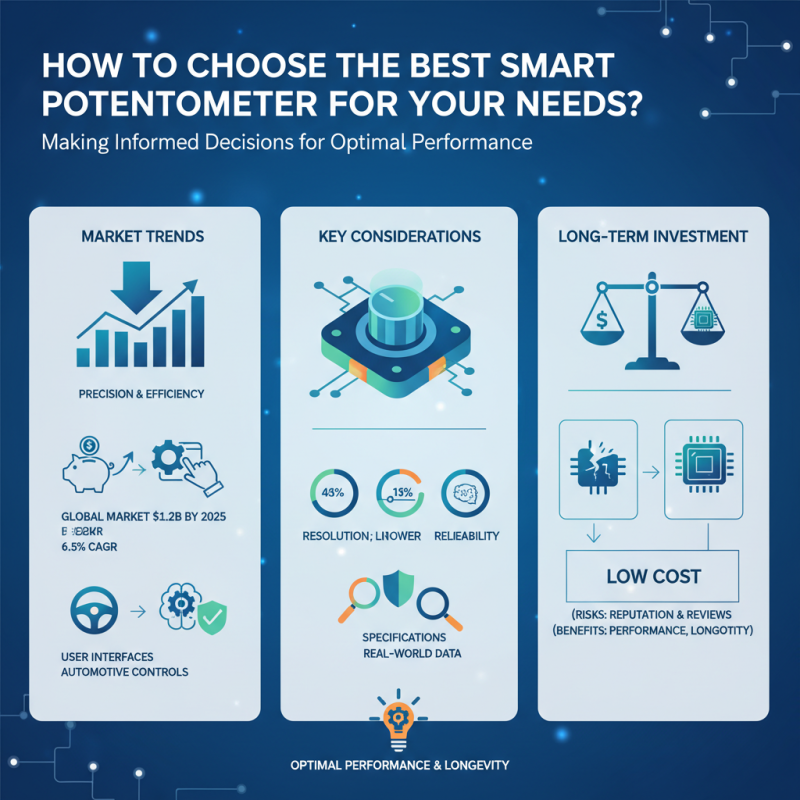
In the rapidly evolving world of electronics, the demand for Smart Potentiometers is increasing. A recent industry report from MarketsandMarkets highlights that the global market for smart potentiometers is projected to reach $1.2 billion by 2025, growing at a CAGR of 6.5%. This growth reflects a significant shift towards more precise and efficient components in various applications, such as user interfaces and automotive controls.
Choosing the right Smart Potentiometer can be challenging. With numerous options available, understanding the specific needs of your project is critical. Factors like resolution, linearity, and power consumption play vital roles in performance and durability. While many brands claim high precision, not all deliver reliable results under different conditions. It is essential to consider both specifications and real-world performance data from credible sources.
Investing in a Smart Potentiometer is often a long-term decision. Some products may appear attractive due to their low cost. However, these options can lead to unexpected failures or inefficiencies. Engineers and designers must weigh the benefits of brand reputation and product reviews against budget constraints, ensuring optimal performance and longevity in their applications.
Understanding Smart Potentiometers: Definition and Applications
Smart potentiometers are vital for modern electronic applications. They allow precise control of voltage and current. These components help in various devices, from audio equipment to robotics. Understanding their definition and applications is crucial for effective selection.
When choosing a smart potentiometer, consider its resolution and range. Higher resolution means finer adjustments, while an appropriate range ensures compatibility with your device. Look for features like self-calibration, as they enhance reliability.
Tip: Always check the data sheet for specifications. This document contains essential information about performance and limitations. Don’t overlook compatibility with your existing systems. It’s essential for seamless operation.
Many users make mistakes in application settings. They might select a potentiometer based on features alone, ignoring how it fits into their project. Reflecting on your project needs can prevent costly errors. Be sure to assess both immediate and long-term requirements.
Key Specifications: Resistance, Power Rating, and Taper Types
Choosing the right smart potentiometer involves understanding key specifications like resistance, power rating, and taper types. Resistance determines how much voltage and current the potentiometer can handle. It's essential to match this value with your circuit requirements. For instance, a low-resistance potentiometer can be beneficial for low-power devices but may struggle in high-power applications. Knowing the correct resistance ensures optimal performance and longevity.
Power rating is another critical factor. It indicates how much power the potentiometer can dissipate without damage. A higher power rating means the component can handle more energy. If a potentiometer exceeds its power limit, it can overheat and fail. This can impact your project's efficiency. Ensure you choose a device with a suitable rating for your specific needs.
Taper types, such as linear or logarithmic, influence how the potentiometer responds to input. Linear taper offers a consistent change in resistance, while logarithmic taper is better for audio applications. The right taper can enhance user experience. Selecting the wrong type may lead to an inadequate response curve. It’s vital to consider the application carefully. Each project may require different specifications for the best results.
How to Choose the Best Smart Potentiometer for Your Needs?
| Specification | Type A | Type B | Type C |
| Resistance (Ω) | 10k | 50k | 100k |
| Power Rating (W) | 0.1 | 0.25 | 0.5 |
| Taper Type | Linear | Logarithmic | Linear |
| Temperature Range (°C) | -40 to 85 | -20 to 70 | -40 to 125 |
| Dimensions (mm) | 7.0 x 12.0 | 10.0 x 15.0 | 9.0 x 14.0 |
Evaluating Precision: Importance of Resolution and Linearity
When selecting a smart potentiometer, evaluating precision is crucial. Two key factors in this assessment are resolution and linearity. Resolution indicates how finely a potentiometer can adjust voltage levels. For example, a 10-bit smart potentiometer can theoretically provide 1024 distinct positions. This granularity is vital for applications requiring nuanced control over output signals.
Linearity, on the other hand, relates to how accurately the output changes in response to input. A potentiometer with high linearity will have a predictable output throughout its range. According to industry reports, devices with linearity discrepancies exceeding 1% can introduce significant errors in sensitive applications. These inaccuracies might lead to undesirable performance in audio systems or control interfaces.
Experience demonstrates that choosing the right specifications plays a vital role. Relying solely on resolution can be misleading. Some components may boast high resolution but lack stability in linearity. Conversely, a component with lower resolution might deliver enhanced performance under certain conditions. Balancing both attributes is essential for meeting specific needs effectively.
Evaluating Precision: Importance of Resolution and Linearity in Smart Potentiometers
Compatibility: Integrating Smart Potentiometers into Your Circuit Design
When selecting a smart potentiometer, compatibility is essential for a seamless integration into your circuit design. Different projects have unique requirements. Understanding those needs will guide your decision. Look at the electrical specifications, such as voltage and current ratings, to ensure a match. Not all potentiometers work well in every scenario.
Consider the protocols used for communication. Many smart potentiometers use standard methods like I2C or SPI. Check if these align with your microcontroller or other components. Compatibility is not just about electrical parameters; software is also crucial. Often, specific libraries exist to support your selected potentiometer. This can save time and effort.
Reflect on the physical dimensions and layout as well. Ensure that the potentiometer fits well within your project. Sometimes, the best choice on paper may not fit your design constraints. Prototypes or simulations can help clarify these issues early on. Listen to feedback from team members, as diverse perspectives often lead to better decisions.
Cost Analysis: Balancing Quality and Budget for Your Project
When selecting a smart potentiometer, cost is a primary concern for many projects. Budget constraints can significantly affect the choice of components. A recent industry report indicates that the global smart potentiometer market is projected to grow at a CAGR of 5.8% from 2021 to 2026. This growth reflects the increasing demand and competition, which may affect pricing strategies. Understanding the balance between cost and quality becomes essential.
High-quality potentiometers often come at a premium price. The materials used and manufacturing standards can greatly influence performance and longevity. A survey of engineers found that 70% prioritize reliability over initial cost. While lower-cost options may be tempting, they may not deliver the expected performance. For instance, a cheaper model might fail under high-stress conditions, resulting in costly project delays.
In many instances, choosing a mid-range product can be wise. It provides a balance of reliability and cost. However, this requires a deeper analysis of specifications and reviews. Projects vary greatly, and a one-size-fits-all solution is rarely effective. Budget allocation must be flexible, allowing room for adjustments if better quality ensures project success.