Why Choose Rack Accessories for Global Sourcing?
Global sourcing is no longer only about finding the lowest unit price. It is about securing dependable Rack Accessories that fit, perform, and arrive consistently. A pallet beam connector, safety pin, or wire decking panel may look small. Yet one incorrect dimension can delay an entire warehouse installation. That detail matters.
Martin Christopher, a leading supply-chain authority and Emeritus Professor at Cranfield University, wrote, “Supply chain management is the management of a network of interconnected businesses involved in the ultimate provision of product and service packages required by end customers.” His view explains why responsible buyers examine the complete sourcing network, not just the product catalogue. They assess material quality, load ratings, production records, packaging, lead times, and after-sales support. Samples should be checked against drawings and real operating conditions. A bright finish alone proves very little.
Experienced procurement teams also compare suppliers across regions. They review steel grades, welding consistency, corrosion protection, inspection reports, and replacement availability. Clear communication helps, especially when measurements cross between millimetres and inches. It can still fail. A rushed specification, unclear tolerance, or missing installation detail may create expensive rework.
Choosing Rack Accessories through global sourcing can improve product variety and supply resilience. It may also reduce dependence on one local source. However, lower prices should never replace technical verification or ethical supplier evaluation. Reliable sourcing requires patience, documented evidence, and honest review after delivery. The best decision is not always the cheapest one. It is the one that keeps people, pallets, and warehouse operations safer over time.
What Rack Accessories Include and Why They Matter
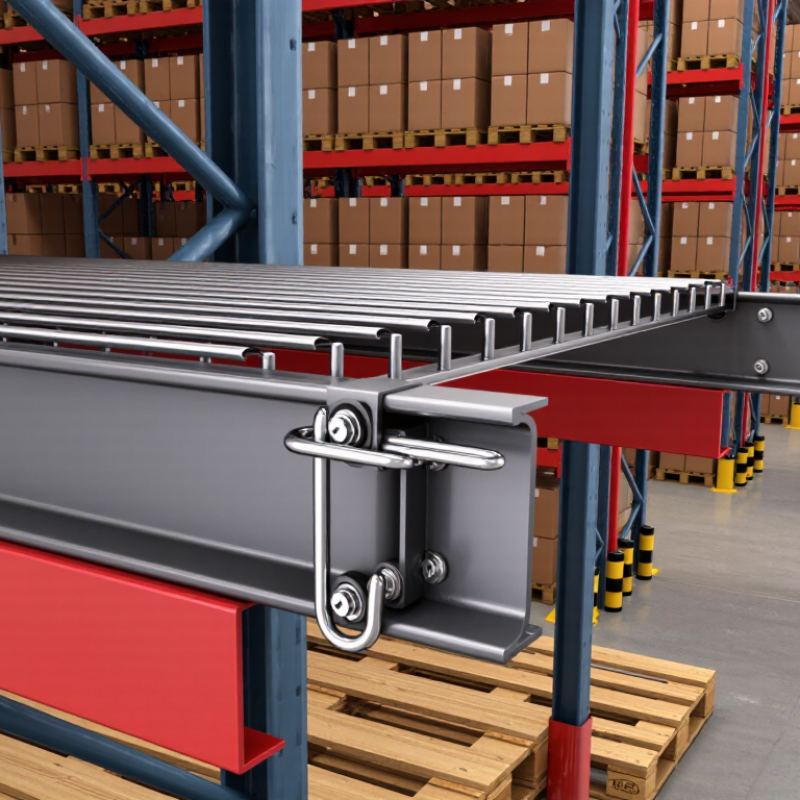
Rack accessories include more than beams and upright frames. They cover pallet supports, wire decking, row spacers, column guards, backstops, safety netting, and guide rails. Each part controls a small operational risk. A pallet support can prevent a load from slipping through. A column guard can absorb a forklift impact before the frame bends. I have seen these minor components decide whether a warehouse remains orderly after one busy shift.
The MHI 2024 Annual Industry Report reported that 55% of supply chain professionals planned to increase technology and innovation investment. That investment also requires reliable physical infrastructure. Accessories improve compatibility with scanners, conveyors, automated equipment, and changing pallet sizes. However, they are not automatically universal. Steel thickness, beam profile, load rating, and local inspection rules must be checked before purchasing. One overlooked measurement can delay an entire installation.
Safety data makes the issue more concrete. The U.S. Bureau of Labor Statistics recorded 1,190 workplace fatalities in transportation and material-moving occupations in 2023. Rack accessories cannot remove every hazard, but guards, mesh panels, and clear aisle protection can reduce exposure. OSHA 29 CFR 1910.176 also requires stored materials to remain stable and secure. Global sourcing adds another concern: specifications may be translated poorly, and test documents may not match the shipment. Ask for load calculations, material certificates, installation drawings, and replacement availability. Cheap parts sometimes create expensive uncertainty.
Why Choose Rack Accessories for Global Sourcing? - What Rack Accessories Include and Why They Matter
| Accessory Category | Typical Materials | Primary Function | Common Specifications | Why It Matters in Global Sourcing | Key Quality Checks |
|---|---|---|---|---|---|
| Pallet Support Bars | Cold-formed steel or structural steel | Supports pallets or loads placed between rack beams | Designed for the beam span, pallet type, and rated load | Improves load stability and allows one rack system to accommodate different pallet designs | Load rating, correct fit, weld quality, straightness, and corrosion protection |
| Wire Decking | Welded steel wire with steel support channels | Creates a stable storage surface on pallet rack beams | Panel width and depth matched to the rack; often includes waterfall supports | Provides visibility, ventilation, and a practical surface for pallets, cartons, and containers | Uniform wire spacing, panel dimensions, beam engagement, welds, and deflection under load |
| Column Protectors | Steel, molded polyethylene, or recycled polymer | Helps shield upright frames from impacts by forklifts and handling equipment | Floor-mounted or rack-mounted designs; dimensions matched to upright profiles | Reduces the risk of rack damage and supports safer warehouse operation | Impact resistance, anchoring method, profile compatibility, visibility, and edge finish |
| Row Spacers | Powder-coated or galvanized steel | Maintains a defined distance between back-to-back rack rows | Length selected according to rack depth and installation layout | Improves row alignment and helps maintain consistent installation geometry | Hole alignment, length tolerance, fastener fit, coating coverage, and structural integrity |
| Back and Side Mesh Panels | Welded steel mesh and formed steel frames | Helps prevent products from falling behind or beside the rack | Mesh aperture, panel height, and fixing method vary by application | Supports housekeeping, product containment, and separation from walkways | Mesh strength, sharp-edge control, mounting security, panel alignment, and visibility |
| Rack Safety Bars | Steel tube or formed steel sections | Provides additional restraint or support at selected rack positions | Position and capacity depend on the stored goods and rack configuration | Useful for irregular loads, drums, containers, and applications requiring extra retention | Connection strength, tube thickness, load suitability, corrosion resistance, and fit |
| Pallet Supports and Guides | Formed steel, steel angle, or structural sections | Helps position pallets and supports consistent loading into rack bays | Selected according to pallet dimensions, beam spacing, and handling method | Improves loading accuracy and reduces the chance of pallet misplacement | Dimensional accuracy, smooth edges, mounting security, and compatibility with pallets |
| Rack Shims and Leveling Plates | Carbon steel or stainless steel | Compensates for minor floor irregularities beneath rack uprights | Available in different thicknesses and plate sizes for base-plate systems | Supports accurate installation and helps maintain upright alignment | Thickness accuracy, flatness, compressive strength, burr removal, and corrosion protection |
| Aisle and Bay Markers | Aluminum, plastic, laminated board, or coated steel | Identifies aisles, rack bays, levels, and storage locations | Printed or coded formats sized for visibility at operational distances | Supports inventory accuracy, warehouse navigation, and faster order picking | Legibility, adhesive or mounting strength, abrasion resistance, and coding accuracy |
| Carton Flow Rails | Galvanized steel, aluminum, or engineering polymer rollers | Allows cartons to move forward by gravity in flow-storage applications | Roller pitch and rail length selected according to carton size and weight | Supports first-in, first-out handling and improves picking access | Roller movement, pitch consistency, slope compatibility, frame fit, and wear resistance |
Note: Accessory selection should be verified against the rack manufacturer’s load data, the applicable local safety requirements, the stored product, and the operating equipment used in the facility.